السلام عليكــم ورحمـة الله وبركاتــه ،،
اثناء التصفح والمتابعه لكتب اللينكس وجدت هذا الكتاب الرائع الذى شوقنى فهرسه الى قراءته اتمنى ان يعجبكم ويفيدكم واسالكم الدعاء
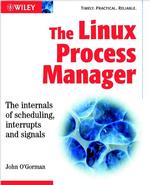
اسم الكتاب The Linux Process Manager
فهرس الكتاب :
1 Introduction
1.1 Overview of the process manager
1.2 The GCC compiler
1.3 Initialising the process manager
2 Representing processes in Linux
2.1 Important fields hard coded at the beginning
2.2 Scheduling fields
2.3 General process information
2.4 Memory management performance information
2.5 Credentials and limits
2.6 Miscellaneous information
2.7 Volatile environment and input–output
2.8 Signal handlers
2.9 Execution domain tracking
2.10 Conclusions
3 Organising the task structures
3.1 Manipulating the linked list of task structures
3.2 The hash table for task structures
3.3 Setting up the initial process
3.4 The idle thread
4 Wait queues
4.1 Wait queue data structures
4.2 Wait queue insertion and deletion
4.3 Generic list handling
4.4 Wait queue locks
4.5 Putting a process to sleep
4.6 Conditionally waiting on an event
4.7 Waking processes up
4.8 Manipulating the runqueue
5 Mutual exclusion with locks
5.1 Bit manipulations
5.2 Atomic operations
5.3 Single-processor version of spinlocks
5.4 Multiprocessor version of spinlocks
5.5 The kernel lock
5.6 Single-processor version of read–write locks
5.7 Multiprocessor version of read–write locks
6 Mutual exclusion with waiting
6.1 Kernel semaphores
6.2 Read–write semaphores
6.3 Completions
7 Scheduling
7.1 Introduction
7.2 Data structures used by the scheduler
7.3 The main scheduler
7.4 Functions used by the scheduler
7.5 Context switching
7.6 Finding an idle processor
8 Process creation
8.1 Data structures and initialisation
8.2 Creating a new process
8.3 Subsidiary functions
8.4 The user cache
8.5 Creating a kernel thread
9 Process termination
9.1 Terminating a process
9.2 Subsidiary functions used when exiting
9.3 Waiting for a child process to exit
9.4 Subsidiary functions used when waiting
10 Interrupting Linux
10.1 The interrupt descriptor table
10.2 Customising the interrupt descriptor table
10.3 Interrupt handling
10.4 System call entry
10.5 Exception handler entry
10.6 Returning from an interrupt
11 Exception handlers
11.1 Generating generic exception handlers
11.2 Debug
11.3 Nonmaskable interrupt
11.4 General protection
11.5 Spurious interrupt
11.6 Machine check
11.7 Device not available
11.8 Co-processor error
11.9 SIMD co-processor interrupt
11.10 Auxiliary functions for co-processor error handling
12 Hardware interrupts
12.1 Programmable interrupt controller
12.2 Data structures for hardware interrupts
12.3 First-level handlers for hardware interrupts
12.4 The second-level hardware interrupt handler
12.5 Hardware interrupts and the interrupt descriptor table
12.6 Requesting and releasing an interrupt line
12.7 The 8259A Programmable interrupt controller
12.8 Interrupt-safe locks
12.9 Functions for reading and writing input–output ports
13 Advanced programmable interrupt controllers
13.1 APIC registers
13.2 Initialising the local APIC
13.3 High-level operations on a local APIC
13.4 Low-level operations on a local APIC
13.5 Sending interprocessor interrupts
13.6 First-level handlers for APIC interrupts
13.7 Second-level handlers for APIC interrups
14 The input–output advanced programmable interrupt controller (the IO APIC)
14.1 Interrupt configuration tables in Linux
14.2 IO APIC registers
14.3 Controller functions for an IO APIC
14.4 Generic IO APIC code
14.5 Global interrupts
15 The timer interrupt
15.1 Timer interrupt handling
15.2 Updating the time-of-day clock
15.3 Event timers
16 Software interrupts
16.1 The software interrupt mechanism
16.2 Tasklets
16.3 Bottom halves
16.4 Task queues
16.5 Interrupt request statistics
17 The signal mechanism
17.1 Data structures used to implement signals
17.2 Bitmap handlers
17.3 Installing a signal handler
17.4 Deallocating signal-handling structures
17.5 Notifying a user before handling signals
17.6 The alternate stack for signal handlers
18 Posting and delivering signals
18.1 Posting signals
18.2 Other signal-sending functions
18.3 Pending signals
18.4 Delivering a pending signal
18.5 Removing a signal from a queue
19 Executing a signal handler
19.1 Handling a signal
19.2 The stack frame for signal handling
19.3 Setting up a stack frame for signal handling
19.4 Setting up signal context on the user stack
19.5 Returning to kernel mode after handling a signal
19.6 Copying information back from user space
20 Capabilities
20.1 Data structures representing capabilities
20.2 Manipulating capability bitmaps
20.3 Setting capability masks
20.4 Checking capabilities
21 Personalities and execution domains
21.1 Data structures supporting personalities
21.2 Data structures for tracking execution domains
21.3 Registering and unregistering execution domains
21.4 Setting a new personality
22 Tracing processes
22.1 Setting up a process to be traced
22.2 Discontinuing tracing a process
22.3 Accessing the memory space of a traced process
22.4 Manipulating register values in the traced process
22.5 Traced process handling a system call
22.6 Displaying debugging information
23 Process accounting
23.1 Data structures
23.2 Freeing disk space
23.3 Writing to the accounting file
23.4 Encoding an unsigned long
24 Virtual 8086 mode
24.1 Data structures
24.2 The virtual flags register
24.3 Macros to read and write memory
24.4 Entering vm86 mode
24.5 Trap handling in vm86 mode
24.6 Handling faults in vm86 mode
24.7 Vectored interrupts in vm86 mode
24.8 Leaving vm86 mode
Index
حجم الكتاب 3.5 ميجا
صيغة الكتاب PDF
روابط التحميل --اختر رابط واحد -- :
http://filaty.com/f/907/90881/Wiley_-_The_...er.pdf.zip.html
http://rapidshare.com/files/257350397/Wile...er.pdf.zip.html
http://www.filefactory.com/file/ahed58f/n/...Manager_pdf_zip
http://www.zshare.net/download/6284924025953c7f/
http://www.easy-share.com/1906815751/Wiley...ager.pdf.zip%22
http://www2.zippyshare.com/v/68629065/file.html
http://netload.in/dateiEJDIAokzcj.htm
http://www.badongo.com/file/16066154
http://depositfiles.com/en/files/vs0st80zm
اتمنى لكم التوفيق
EraMaX
